

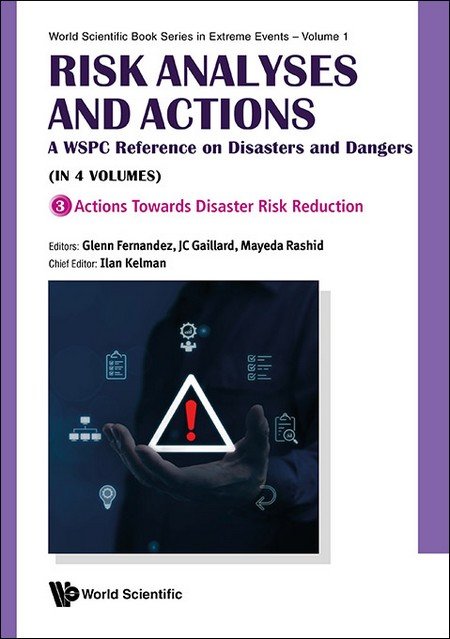
Dr Johnrev Guilaran published a chapter, “Disasters and Mental Health,” as part of the World Scientific Book Series in Extreme Events: Risk Analyses and Actions. The chapter is part of Volume 3, which focuses on actions towards disaster risk reduction. The chapter discusses the history of disaster and mental health, the various psychological reactions to disasters, models explaining disaster behavior, and psychological treatments associated with the negative effects of disasters. it also discusses some decolonial perspectives to disaster and mental health. The book was edited by Ilan Kelman (University College London, UK), and the volume was edited by Glenn Fernandez (Rabdan Academy, UAE), JC Gaillard (University of Auckland, Aotearoa New Zealand), and Mayeda Rashid (Monash University, Australia).
Abstract:
Disasters can be overwhelming due to their deleterious effects. This chapter covers the mental health consequences of disasters, models explaining the link between disasters and these psychological responses, and the principles and modalities that address these consequent mental health concerns. It begins with a presentation of the historical roots of disaster mental health, followed by a discussion of disasters and psychological trauma. The various psychological reactions to disasters are then summarized, including grief and loss and resilience. A discussion of the psychological consequences of responding to disasters is also presented. Several models explaining how disasters affect mental health outcomes are discussed, including the Conservation of Resources (COR) theory and the Social Support Deterioration Deterrence (SSDD) model. This chapter also discusses the principles of mental health and psychosocial support services (MHPSS) and presents the various psychosocial interventions after disasters, including psychological first aid (PFA) and other therapeutic modalities. Finally, this chapter argues for the decolonization of disaster mental health that focuses on Indigenous and historically marginalized voices and community mental health approaches that promote resilience and transformation in the face of these adversities.
From the book blurb:
Risk Analyses and Actions: A WSPC Reference on Disasters and Dangers, connects and integrates the perils, threats, exposures, and hazards that permeate humanity’s existence on Planet Earth. The chapters bring together the difficulties and challenges faced by individuals and collectives — both hourly and across millennia — with outcomes often realized as disasters, emergencies, tragedies, calamities, crises, and catastrophes.
The underlying ethos throughout, and the unifying theme across the four volumes, is that the vast majority of these problems are human-made and need not exist. Vulnerabilities are created, perpetuated, and sustained, rather than being tackled, managed, and reduced. The authors demonstrate how dangers and disasters are expressions of the actions and analyses that humanity fails to undertake in order to acknowledge, address, and rectify risks. They also show that when humanity chooses appropriate and proactive pathways, the rewards can be both immediate and long-lasting.
This volume foregrounds the complexity of local contexts, lived experiences, and diverse worldviews that shape how disasters are understood and addressed. It introduces readers to both longstanding and emerging challenges in disaster risk reduction (DRR), while outlining a range of tools, strategies, and approaches available for tackling them. Rather than offering one-size-fits-all solutions, the volume underscores the need for context-sensitive action, acknowledging potential obstacles to implementation. Serving as both a practical resource and a reflective guide, it calls for action rooted in inclusivity, adaptability, and respect for local realities — highlighting the importance of navigating complexity with clarity and care.
Book DOI: https://doi.org/10.1142/14391-vol3
Chapter DOI: https://doi.org/10.1142/9789819816132_0002

